01
The System
A political order that answers to citizens between elections, with local governments that cannot be switched off.
- Who answers when public services fail?
- How do local governments get power and money?
An independent citizens’ platform
For a year the same word has come up in drawing rooms, studios and timelines: reset. Reset Pakistan is where that argument happens in the open. We make the case for a big reset of the political system, the bureaucracy and the map of the provinces, and we give equal room to everyone who disagrees.
Why a reset
An average province now governs about 60 million people from a single capital. Supporters of a reset say decisions sit too far from the people they affect. Critics say smaller units will not fix weak institutions on their own, and will cost money. Both arguments belong here.
Source: Pakistan Bureau of Statistics, 7th Population and Housing Census 2023.
Read
The plan
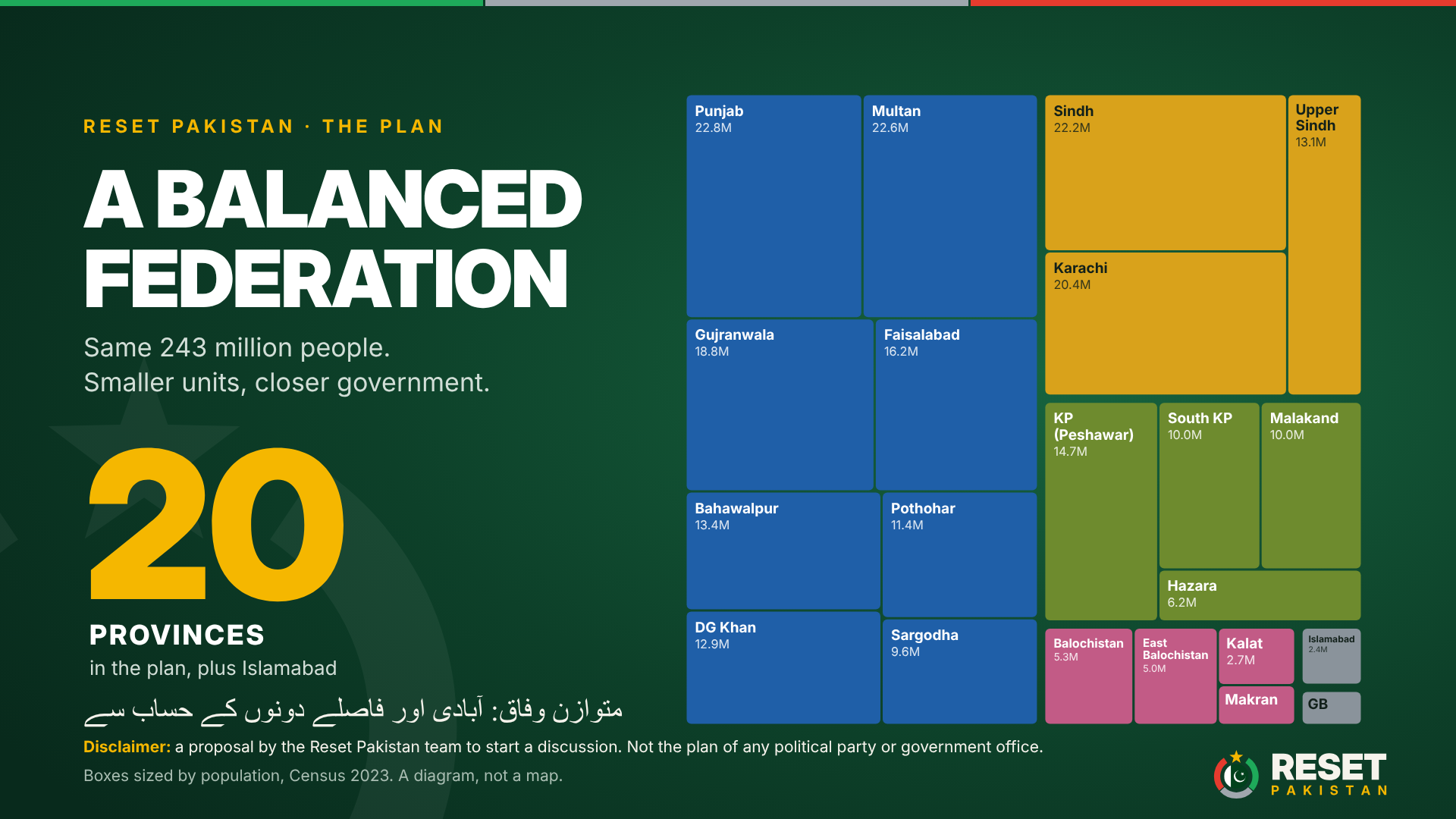
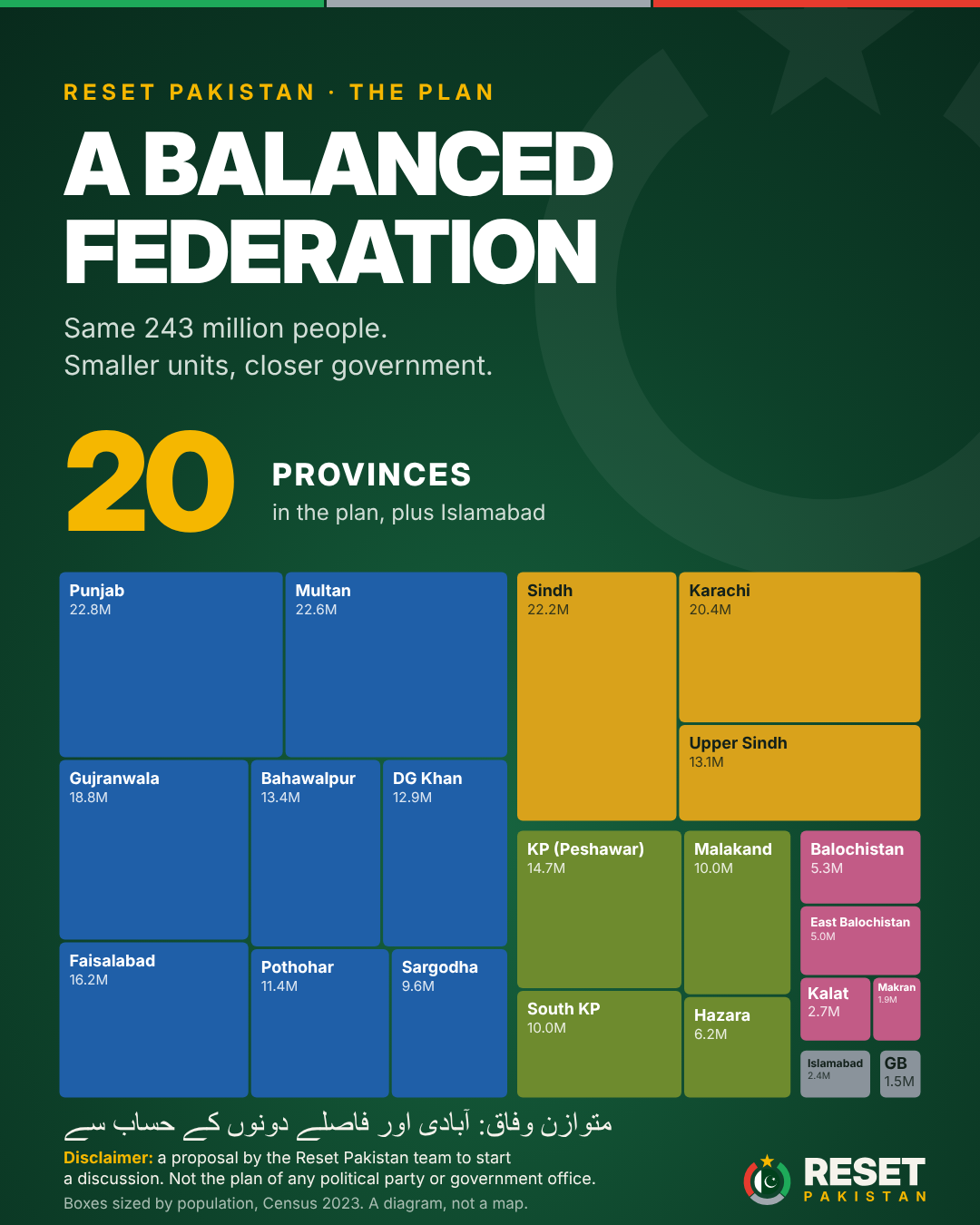
20 provinces built from existing divisions and tested against the G20: none above 25 million people or much above 100,000 km². Balochistan gets four seats of government and a resource compact. Every unit is costed.
Read the plan →
Pakistan has grown more than sevenfold since 1951. The number of its provinces has not changed. That is why a reset starts with the map.
Read →The costThe loudest argument against new provinces is the price of more governors, ministers, secretariats and protocol. It deserves numbers, not slogans.
Read →The serviceThe government’s own reform committee says the civil service still runs on a colonial design. New provinces without a new service would only copy the old one.
Read →The systemThe Constitution promises elected local governments with real powers. In practice they come and go at the pleasure of provincial governments. That has to end.
Read →What needs a reset
A political order that answers to citizens between elections, with local governments that cannot be switched off.
A bureaucracy hired on merit, measured on results and built to serve the public.
Government sized for 242 million people and 880,000 km²: smaller provinces built from existing divisions.
How we cover it
For the reset
Statements and proposals that support a reset, and the case their authors make for it.
Undecided · neutral
Conditional, procedural or open positions: “yes, if”, “not like this” and “let’s debate it first”.
Against the reset
Statements that oppose a reset, and the strongest version of their reasons.
We label statements, not people. A colour describes what someone said on one question, on one date, with the source linked.
The debate board
21 green · 16 grey · 13 red, across three questions
Said a referendum will decide whether new provinces are created, called December a crucial month, and argued that power has been concentrated in the chief minister's house.
Said Article 239 is the only valid route and a referendum cannot replace it, and argued new provinces alone would not make government work better.
Said Pakistan's economy cannot bear the cost of extra assemblies, secretariats, chief minister and governor houses and courts, asking whether a province is like a new housing society.
Manifesto
Decades of quick fixes have left a system that no longer responds. We argue for structural change, openly.
Smaller provinces and real local government, so decisions are taken near the people who live with them.
Merit in hiring, accountability for results, and citizens treated as customers rather than supplicants.
Change comes through debate, Parliament and the consent of the people affected. Changing a province’s limits needs two-thirds of each house and two-thirds of that province’s assembly under Article 239(4). No shortcuts.
Our view is green, and we publish red and grey with the same care. An argument we cannot answer deserves a wider audience.
Every claim is linked and dated, and every proposal comes with its price. No fake quotes, no abuse, no personal attacks. Corrections are made in public.
Join the debate
Follow us, pick your colour and tell us why. The best arguments from every side are featured each week, with credit.
Debate it. Decide it. Reset it.