Blog · Today’s analysis
Votes, not threats: the arithmetic that decides any new province
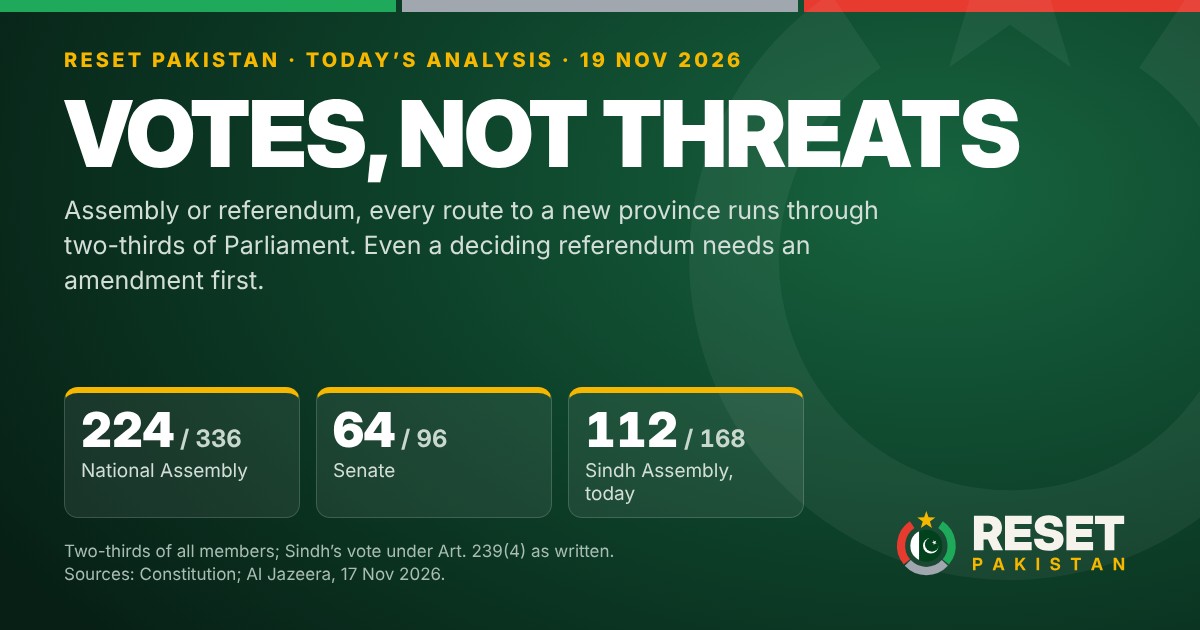
In two days, 17 replies answered PPP Chairman Bilawal Bhutto Zardari’s warning on Sindh. One side says let the people vote; the other, that the Sindh Assembly has already spoken. As written, the Constitution needs two-thirds of Parliament and of the province’s own assembly. Parliament could amend it to let a referendum decide, but that too needs two-thirds. Every route runs through votes.
On Tuesday, at the Karachi Press Club, PPP Chairman Bilawal Bhutto Zardari rejected a referendum on new provinces and warned that if Sindh were divided by force, blood would flow in its streets.[1] Within two days our debate board had logged 17 replies from ministers, parties, religious leaders and commentators. On Wednesday night he answered back: he had been “sounding the alarm, not issuing a threat”.[2]
Who answered, and how
Replies to the 17 November remarks on our debate board, by stance
- Green Light: back new provinces10 · 58.8%
- Grey Zone: conditional or neutral5 · 29.4%
- Red Line: against2 · 11.8%
Two arguments that never meet
Most replies made one of two cases. The first: let the people decide. Federal Information Minister Attaullah Tarar said a referendum is a constitutional way to learn what people want, and that new provinces should be made if they want them.[3] MQM-P went further and asked for a nationwide vote in December, under Article 48(6), before 2027 begins.[4] The Mohajir Ittehad National Movement asked for the same.[5]
The second: Sindh has already answered. PPP spokesperson Shazia Marri said repeated Sindh Assembly resolutions should have settled the matter.[6] JUI-F called Bilawal Bhutto Zardari’s view realistic and warned that a referendum could be misused, like emergency powers.[7] Punjab Governor Sardar Saleem Haider Khan, who is from the PPP, said the people of Sindh do not want division and nothing can be imposed on them.[8]
Both sides are arguing about consent. Neither is spelling out the procedure, and there are three ways it could go.
Three routes, and what each can do
| Referendum under today’s rules (Article 48(6)) | Amendment as written (Article 239) | Amend first, then let a referendum decide | |
|---|---|---|---|
| Who starts it | The prime minister, and only after a joint sitting of Parliament approves it.[10] | A bill in either house of Parliament.[23] | A bill to write a new rule into the Constitution, for example that a province is created if voters approve it.[22][24] |
| Votes in Parliament | A majority of the joint sitting, to call the vote. | Two-thirds of each house: 224 of 336 MNAs and 64 of 96 senators.[11] | The same two-thirds, 224 and 64, to pass the new rule.[11] |
| Say of the province | None written in. | Two-thirds of that province’s own assembly before assent: 112 of 168 in Sindh, 248 of 371 in Punjab.[11][23] | Disputed. One view: the new rule also needs every provincial assembly. Another: Article 239(4) covers only boundary changes.[22][24] |
| Is the result binding? | No. Lawyers say it cannot override Article 239.[9][22] | Yes. It is the route the Constitution provides today.[11] | Yes, once the new rule is in force and if the courts uphold it. Critics say a national vote on one province’s land would break the federation’s consent.[9][28] |
| Example | The clause was added in 1985 under military rule; the 18th Amendment (2010) made Parliament’s approval a condition.[9][10] | In 2013 the Senate passed a bill for a Bahawalpur-South Punjab province; it lapsed with the National Assembly.[11] | Nigeria: a new state needs a referendum backed by two-thirds of the people of the area, plus votes in state assemblies and both houses.[25][26] |
Under today’s rules, a referendum can show what people think, but it cannot move a single boundary.[9] It could become the deciding vote, but only if Parliament first writes that into the Constitution.[22][24] Nigeria works this way: a new state there needs a referendum backed by two-thirds of the people of the area, as well as votes in its legislatures.[25][26]
Every route starts in the same place, though: two-thirds of both houses of Parliament. In July 2025 the ruling coalition held 235 of the National Assembly’s 336 seats, and 74 of them were the PPP’s.[27] Without the PPP, the coalition falls well short of the 224 it needs. Whichever route is chosen, the PPP’s votes count.
The numbers that decide Sindh today
Who holds Sindh’s 168 seats
Sindh Assembly, 168 members. Changing the province needs two-thirds of all members (Article 239(4)).
Under the rule as written, Sindh’s assembly has the last word. It has 168 members. Changing the province needs 112 of them, and any 57 can stop it.[11] The PPP alone has 118: enough on its own either to pass a change or to block one.[12] On 3 September its members passed a unanimous resolution against any division as the opposition walked out.[13]
So, as the Constitution stands, no province can be carved out of Sindh unless Sindh’s elected members agree. Changing that rule would itself take two-thirds of Parliament, and it would be challenged in court. Either way, the decision sits with people who vote: 168 members in Karachi, 432 in Parliament in Islamabad, or the voters themselves. It does not sit on the street, which is why threats are pointless on both sides.
On language
We flagged PPP Chairman Bilawal Bhutto Zardari’s 17 November words because they invoked violence, and we apply that flag to every side.[1] His clarification is on the board as he gave it.[2] Some replies crossed lines of their own. MQM-P central leader Zahid Malik said he spoke like a mafia boss.[15] Federal Defence Minister Khawaja Muhammad Asif asked whether his hands were clean.[14] Younus Memon, Secretary General of the Mohajir Ittehad National Movement, asked for governor’s rule in Sindh, or for Karachi to be run by the federation.[5] Insults and calls to suspend an elected government are shortcuts too. None of them wins a single vote, in any assembly or at any ballot box.
What happens next
JUI-F chief Maulana Fazlur Rehman addresses the Peshawar High Court Bar.[18]
A committee of Sindhi nationalist parties plans a rally in Karachi, according to Ummat.[17]
MQM-P rally on Shahrah-e-Faisal for new administrative units,[16] and a Sindh Taraqqi Pasand Party rally against division on the same day.[12] Ummat reports that Section 144 is in force and no permission has been given.[17] Update, 22 Nov: the MQM-P postponed its rally on 19 November over security concerns and will announce a new date.[29]
The month MQM-P has proposed for a nationwide referendum.[4]
When a 28th Amendment on new provinces could be taken up, according to a report in The News.[19]
Two rallies on opposite sides of this question, in one city, on one day, is a risk no one should want. We ask both organisers and the Sindh government to agree separate times and routes, and every speaker on every side to keep it peaceful.
Our view
Reset Pakistan argues for new provinces, Karachi among them, and we think the people affected should have a direct say. A referendum can give them that say, if Parliament first writes it into the Constitution with clear rules: who votes, what majority counts, and an independent Election Commission to run it. What a referendum cannot be is a shortcut around the Constitution.
Whichever route is chosen, our case has to win votes in Sindh, not only in Islamabad. That means answering Sindh’s fears in writing: how its share of federal money and of Indus water would be divided, which neither the Constitution nor the 1991 Water Accord says today,[11] and how every new unit would protect the languages and people already living in it. Votes can be won. Threats only lose them.
The other side
What critics say
- The Sindh Assembly has already said no, unanimously, and the Constitution gives its elected members the final word on Sindh’s boundaries.[13]
- Pakistan’s referendum clause was born under military rule, and JUI-F warns that a vote could be misused.[9][7] Critics add that rewriting Article 239 so a vote can redraw a province would remove the consent that holds the federation together.[28]
- New provinces cost money. One estimate puts splitting Punjab into three at Rs47–56 billion a year, before set-up costs, and nothing says how money or water would be shared.[11]
- The Human Rights Commission of Pakistan warns that new provinces must not weaken the federation or come at the cost of local government.[20] Some analysts call them desirable but not feasible now, and want protected local government first.[21]
This post states Reset Pakistan’s opinion. Statements by others are summarised in our words and linked to the original reporting.
Sources
- Dawn, 17 Nov 2026: In hard-hitting speech, Bilawal says system was ‘made to collapse’
- Geo News, 18 Nov 2026: ‘They have decided to fight me for speaking truth’: Bilawal counters Centre’s criticism
- The Nation, 18 Nov 2026: Let people decide on new provinces: Tarar
- Dawn, 18 Nov 2026: MQM-P demands nationwide referendum on new provinces next month
- UrduPoint (NNI), 18 Nov 2026: Mohajir Ittehad National Movement on Bilawal Bhutto’s remarks (Urdu)
- ARY News, 18 Nov 2026: Shazia Marri clarifies Bilawal Bhutto’s remarks on division of Sindh
- The Nation, 18 Nov 2026: JUI-F endorses Bilawal’s stance on provincial division, warns against misuse of referendum
- UrduPoint (NNI), 18 Nov 2026: Governor Punjab Sardar Saleem Haider Khan on new provinces (Urdu)
- The Friday Times, 16 Nov 2026: Can a referendum override the Constitution? The case of new provinces
- Constitution (Eighteenth Amendment) Act 2010, section 15: Article 48(6)
- Al Jazeera, 17 Nov 2026: Is Pakistan about to carve out new provinces? Inside the controversial plan
- Dawn, Oct 2026: Major parties’ conference resolves to resist division of Sindh
- The Express Tribune, Sep 2026: ‘Sindh is one, shall remain one’: Assembly passes resolution against division of province
- ThePrint, 18 Nov 2026: Bilawal speech sparks coalition row (Khawaja Asif’s reply on X)
- M News, 18 Nov 2026: Zahid Malik calls Bilawal’s statement political hypocrisy (Urdu)
- Daily Times, 2 Nov 2026: MQM-P launches campaign for new administrative units with major Karachi rally planned
- Ummat, 10 Nov 2026: Rallies planned in Karachi on 22 and 29 November (Urdu)
- UrduPoint (NNI), 18 Nov 2026: Maulana Fazlur Rehman to address Peshawar High Court Bar on 21 November (Urdu)
- Minute Mirror, 9 Nov 2026: Pakistan considers 12-province plan, referendum ahead of possible constitutional amendment
- ANI, 16 Nov 2026: Pakistan human rights body warns of escalating threats to democracy (HRCP General Body)
- Daily Jang, 11 Nov 2026: Saleem Safi, ‘New provinces or a new dispute’ (Urdu column)
- The Express Tribune, Aug 2026: Legal debate intensifies over new provinces
- Constitution of Pakistan, Part XI: Amendment of Constitution (Article 239)
- Republic Policy, Aug 2026: A roadmap for creating new provinces in Pakistan
- International IDEA: Nigeria, Constitution of 1999, section 8 (mandatory referendum for a new state)
- Leadership via AllAfrica, Jul 2025: Constitution review: 46 proposed states fail five key criteria
- Dawn, Jul 2025: Govt takes commanding lead after being handed reserved seats (PML-N 123, PPP 74, coalition 235)
- The Friday Times, 15 Nov 2026: A referendum cannot divide the federation
- The Express Tribune, 19 Nov 2026: MQM-P renews demand for new provinces; party postpones Nov 29 rally over security concerns